Jokes aside...
Урок по морфологии английского языка и культурным контекстам на примере юмористических скетчей
Илья Зыченко
Илья Зыченко
Morphology is one of the key aspects of grammar, and not only it's essential in literal communication, but may also be used to create additional and nuanced meanings, especially in humorous ways.
In this lesson we will delve into some examples of humourous content and try to connect different grammatical instruments (mainly morphology but not only) and the content
In this lesson we will delve into some examples of humourous content and try to connect different grammatical instruments (mainly morphology but not only) and the content
Morphology is the study of how things are put together, like the make-up of animals and plants, or the branch of linguistics that studies the structure of words.
In morphology, the word part morph- means "form" and -ology means "the study of." So, those who study how something is made or formed are engaged in morphology. In biology, the morphology of fish might investigate how the gills work as part of the respiratory system. In language morphology, you might study how prefixes and suffixes added to a word change its meaning.
It explains how changing or combining word parts alters meaning or grammatical function. By studying word parts like prefixes, suffixes, and Latin or Greek roots, they can better decode unfamiliar words and gain a deeper understanding of language in different subjects.
- Prefixes are added at the beginning of a word
- Suffixes are added at the end of a word
- Latin roots provide the core meaning of a word
- Greek combining forms offer additional depth to vocabulary
- Morphemes (Elements of Morphology)
- Compound words
- Hyphen
- Hyphenated compound words
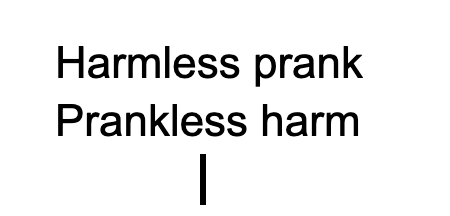
- Practical jokes and pranks
- Puns and 'Dad Jokes'
- Sketches and skits
Practical (and 'impractical') jokes
A practical joke is a physical trick or mischievous prank played on someone to cause lighthearted embarrassment, surprise, or confusion. Unlike verbal jokes, it relies on physical actions or staged setups—such as whoopee cushions, rigged office desks, or hidden sound devices—with the goal of eventually revealing the trick to the victim.
Key Characteristics
Key Characteristics
- Physical Action: Involves setting up an object or environment rather than just telling a story.
- Temporary Confusion: Intended to amuse or startle rather than cause genuine harm, property damage, or fraud.
- The Reveal: A true practical joke ends with the target learning they have been pranked so everyone can share a laugh.
April fools by Simpsons
The only Homer's weakness
The noun is formed by adding the suffix -ness to the adjective. This is a common way to form nouns from simple adjectives e.g. Sad-ness, happi-ness (the y is replaced with i), nervous-ness.
The verb can be formed by adding the suffix - en to either the adjective or the noun. When to use what is can only be mastered with practise — there are no rules. For example: weak - to weaken, broad - to broaden (the noun is breadth), BUT strong (adj) - strength (noun) - to strengthen
long - length - to lengthen etc.
Im-practical jokers
SNL skit
- Am I on 'Impractical Jokers' right now? Am I being impractically joked upon?Cause I cannot let it happen again!
- I want my car to run well (adv)
Negative prefixes in English are word beginnings added to create the opposite or contrary meaning of a base word. The most common are un- (unhappy, undo), in- (correct → incorrect), im- (possible → impossible, used before p/b/m), il- (legal → illegal, before l), ir- (regular → irregular, before r), dis- (agree → disagree), non- (fiction → nonfiction), and mis- (understand → misunderstand, implying wrongly). Choice of prefix often depends on the word's origin (Latin vs. Germanic) and phonetic rules rather than a single consistent rule, so learners often need to memorize which prefix pairs with which word.
A not-so-friendly video
SNL skit (transcript)
- They use different ways to create new words (especially verbs)
- I spend 1000s of dollars 'Honey-I-Shrunk-the-Kids'-ing my brother (Gerund from a verb from a hyphenated phrase)
- 'Social puppeter-ing' (Gerund)
- I vampired my brother (Verbing a noun)
- You got '21-Jump-Street'-ed (Past Participle from a verb from a hyphenated title)
The video in playing a trick on YOU (the viewer)! Try to find them
Hyphenated compound words are formed when two or more words are joined by a hyphen to act as a single unit, as in well-known, mother-in-law, or self-esteem. They typically arise when the compound functions as an adjective before a noun (a well-behaved child), when combining words would be confusing or hard to read (re-cover vs. recover), or in certain fixed expressions and titles (editor-in-chief, X-ray). Hyphenation is the most fluid area of English compounding—many compounds shift over time from open (ice cream) to hyphenated (ice-cream) to closed (icecream-style) forms—and style guides differ, so consistency within a document matters more than any universal rule.
Gaslit vs Gaslighted
SNL skit (transcript)
Here are examples of irregular verbs with variant/competing forms (like dive → dived vs. dove), where usage differs by region or register:
- dive → dived (British) / dove (American)
- dream → dreamed / dreamt
- learn → learned / learnt (British prefers learnt)
- burn → burned / burnt
- spell → spelled / spelt (British prefers spelt)
- spill → spilled / spilt
- leap → leaped / leapt
- plead → pleaded / pled (American legal usage often pled)
- sneak → sneaked / snuck (American informal snuck)
- hang → hung (object) / hanged (execution)
- shine → shone (light) / shined (polished)
- lie → lay / lain (recline) vs. lie → lied (tell an untruth)
- wake → woke / waked
- wed → wedded / wed
- get → got / gotten (American participle gotten; British got)
- prove → proved / proven (participle)
- saw → sawed / sawn (participle, British)
- sew → sewed / sewn
- show → showed / shown
- mow → mowed / mown
- swell → swelled / swollen
- strive → strived / strove
- thrive → thrived / throve
- cleave → cleaved / clove / cleft (and meaning splits: "split" vs. "cling")
- bid → bid / bade (offer vs. greet)
- bear → bore / borne (carry) vs. born (birth)
- shave → shaved / shaven (participle)
Hyperhyperbole
Family Guy parody on whine-wine merge
1. Times, Numbers, and Quantities (Approximate)
We add -ish to numbers, ages, or times to mean "around," "roughly," or "close to". [1, 2]
2. Adjectives (Somewhat or Fairly)
We add -ish to existing adjectives to show that a quality is present to a small or moderate degree. [1, 2]
3. Nouns to Adjectives (Like or Having the Style Of)
We add -ish to nouns to mean "characteristic of" or "similar to" that noun. [1, 2]
4. Standalone Informal Use
In casual spoken English, you can say "Ish" all by itself as a short, vague answer meaning "sort of," "kind of," or "partly". [1, 2, 3]
We add -ish to numbers, ages, or times to mean "around," "roughly," or "close to". [1, 2]
- Time: "Let's meet at seven-ish" (around 7:00 PM).
- Age: "He looks forty-ish" (about 40 years old).
- Quantity/Price: "That will cost twenty-ish dollars". [1, 2, 3]
2. Adjectives (Somewhat or Fairly)
We add -ish to existing adjectives to show that a quality is present to a small or moderate degree. [1, 2]
- Colors: Greenish, reddish, darkish (almost that color, or a mix of it).
- Descriptions: Tallish (fairly tall), oldish (somewhat old), coldish (moderately cold). [1, 2, 3, 4]
3. Nouns to Adjectives (Like or Having the Style Of)
We add -ish to nouns to mean "characteristic of" or "similar to" that noun. [1, 2]
- Behavior/Appearance: Childish (like a child), babyish (like a baby), bookish (fond of books). [1, 2, 3]
4. Standalone Informal Use
In casual spoken English, you can say "Ish" all by itself as a short, vague answer meaning "sort of," "kind of," or "partly". [1, 2, 3]
- Example: "Did you finish your work?" — "Ish." (Meaning: mostly, or to some degree). [1]
Upper RP (U-RP) or posh English
When we think of stereotypical British English spoken by the nobility and/or royalty and other sorts of aristocracy we mean U-RP. It is considered old-fashioned and obsolete and realistically used either by old people in some isolated communities or for humorous purposes. Somewhere using U-RP may even be seen as arrogant and rude.
There are many nuances in pronouncing vowels in U-RP and you may read more about it here. But in terms of consonants it has some features illustrated in the videos below.
The first sketch is about a headmaster (a head of a school in the UK) which tries to sound posh and highbrow not only in the way he organises his speech but the sounds themselves. Most notably he says 'Whatsoever' pronouncing the [H] and this is typical of U-posh and some accents of the American South, but next time he overdoes it and adds the sound where it is not supposed to be (Wednesday).
Historically words spelled with WH- were pronounced like that, but in the process called 'whine-wine merge' they became homophones. The second video is a compilation of the WH- moments from Family Guy highlighting the humorous effect of using outdated pronunciation.
Also worth mentioning the tapped R in the U-RP which is associated with BBC announcers (example) used in the first sketch.
Some pun intended
No pun intended (even though it was)
Some Dad Jokes